
- Written by: The Mind Initiative
- September 19, 2026
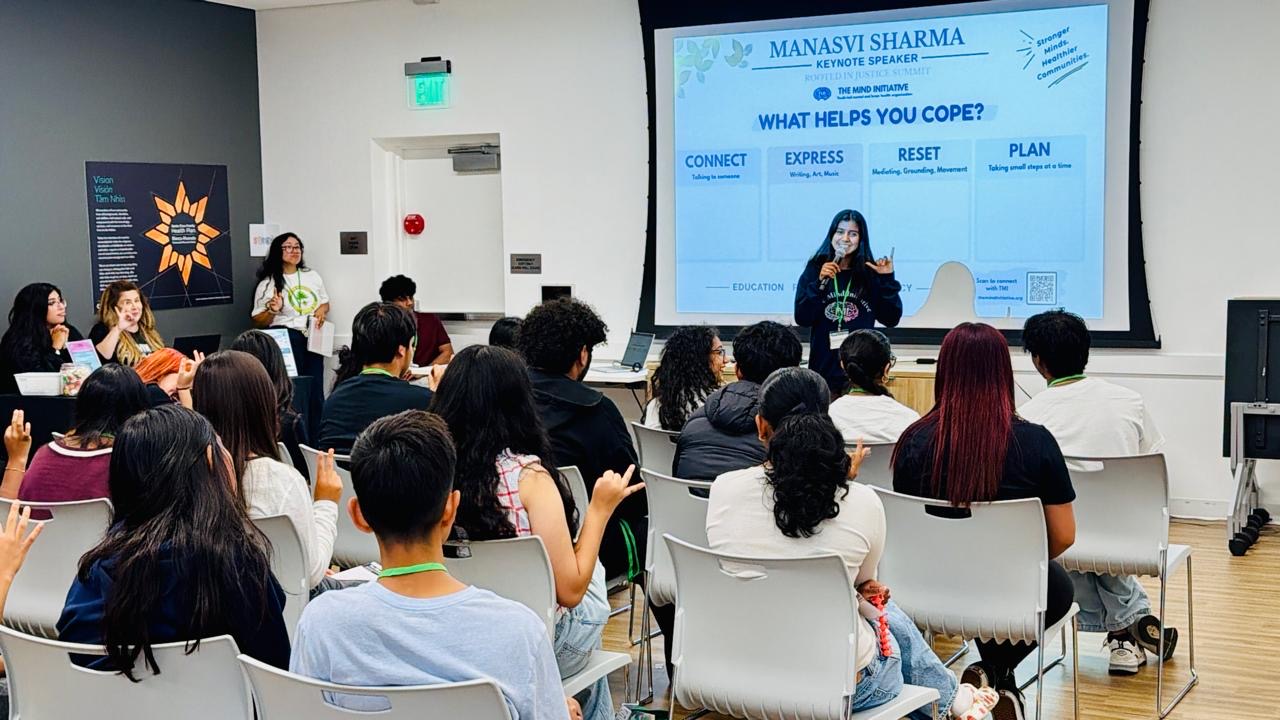
The Mind Initiative was honored to deliver a keynote at the Rooted in Justice Summit, organized by the Santa Clara County Public Health Department. Our Founder & Executive Director, Manasvi Sharma, spoke on youth nicotine prevention, brain health, stress, and healthy coping.
We wanted to know whether young people left with a clearer understanding of these ideas, so we evaluated the keynote with pre- and post-surveys. This report shares what we found.
The Session
The session covered five connected ideas:
• How nicotine affects the developing brain
• Why young people may seek immediate relief from stress
• How peers and other outside influences shape decisions
• How repeated coping patterns can become unhealthy habits
• Why effective coping is individual, and how young people can match their own strengths with resources that work for them
The last point mattered most to us. There is no single “right” way to cope, and prevention works better when young people can identify what already works for them.
How We Evaluated It
Participants completed surveys before and after the keynote. They rated their understanding of six concepts on a 5-point scale and rated their confidence on three statements on a 4-point agreement scale. They also answered an open-ended question about coping and takeaways.
• 24 participants provided open-ended responses.
• 23 participants completed the full quantitative pre/post measures.
Because the sample is small and the ratings are ordinal, we used paired Wilcoxon signed-rank tests.
Quantitative Findings
Understandings grew across the board.
Across the six knowledge areas, average self-reported understanding rose from 3.42 to 4.39 out of 5, an average gain of nearly one full point (+0.97). 22 of 23 participants (95.7%) increased their overall understanding score, one stayed the same, and none decreased. The overall improvement was statistically significant (p < .001).
| Knowledge area | Before | After | Change |
|---|---|---|---|
| Why people seek immediate relief | 3.30 | 4.57 | +1.26 |
| How nicotine affects the brain | 3.48 | 4.52 | +1.04 |
| Matching strengths with resources | 3.30 | 4.30 | +1.00 |
| How stress affects brain health | 3.35 | 4.26 | +0.91 |
| How repeated patterns shape the brain | 3.48 | 4.35 | +0.87 |
| How external influences affect choices | 3.61 | 4.35 | +0.74 |
More participants reported strong understanding
We also looked at the share of participants rating their understanding as 4 (“well”) or 5 (“extremely well”):
• Repeated patterns shaping the brain: 43.5% → 91.3%
• Stress and brain health: 43.5% → 87.0%
• Nicotine and the brain: 56.5% → 95.7%
• Why people seek immediate relief: 52.2% → 91.3%
Confidence moved in the right direction
On a 4-point scale, composite confidence across three measures (seeking the right resource, recognizing unhealthy coping, and identifying influences on choices) rose from 2.99 to 3.48 (p < .001). About 65% of participants increased their confidence score, and no one decreased. The share who agreed they could recognize unhealthy coping rose from 87% to 100%.
A note on the full picture
The results were not uniformly upward for every individual. One participant, for example, rated their understanding of matching strengths with resources lower afterward (5 → 2), and a few others had small decreases on individual items. We kept these in the analysis. They are part of an honest picture, and they remind us that a single keynote/workshop does not land the same way for everyone.
What Participants Told Us
The open-ended responses showed what stuck with participants.
1) Coping is not one-size-fits-all. This was the clearest theme. Participants wrote things like “Different ways to cope,” “A lot of ways to cope,” and “Different things work.”
2) Strengths and resources. Some responses reflected the strengths-to-resources framework directly. One participant wrote that “Everyone has different strengths that work for them,” another named self-reflection as their strength, and another described having a best friend to talk to as theirs.
3) Stress and habits. Participants described how “stress leads to bad habits” and how unhealthy coping can become habitual, while also noting that “stress can be dealt with.”
4) Nicotine avoidance. Some takeaways were direct: “Don’t smoke” and “To not use nicotine.”
5) “I am more than my stress.” Several participants wrote versions of this, and it may be the most meaningful finding in the report. Separating identity from stress is a foundation of resilience, and it shows participants engaging with the message on a personal level, not just recalling facts.
6) Existing supports remain valuable. Before and after the keynote, participants named music, friends, sports, sleep, painting, and time outside as ways of coping. The keynote did not replace these strategies. It helped put them in context.
Limitations
This was a small, non-randomized pre/post evaluation with no control group, so we can say the keynote was associated with these increases, not that it caused them. All measures are self-reported. We measured perceived understanding and confidence, not tested knowledge or behavior. Our survey did not ask whether participants found the keynote helpful, so we do not report a satisfaction rate. Participants reported remembering messages like nicotine avoidance. We cannot say whether their future behavior will change.
Beyond The Workshop
The Summit also gave TMI the chance to connect with public health professionals, youth-serving organizations, and potential partners. Those conversations are helping us explore future collaboration in youth mental and brain health prevention.
Looking Ahead
After a single keynote and workshop, young people reported understanding more about how stress, nicotine, and habits interact with the brain. They also showed they were beginning to see their own strengths as part of the solution. We are grateful to the Santa Clara County Public Health Department for the invitation and to every participant who shared their thoughts, and we look forward to building on this work.
What we delivered: Keynote presentation • Youth nicotine prevention education • Stress and coping education • Pre/post evaluation • Public health networking and partnership development